


Written by Dr Samuel Heitner
Consultant Paediatrician and Founder of Telebaby
Newborn babies can do some surprising things.
They may pause briefly between breaths, strain and turn red before passing a soft poo, bring up milk after feeds or develop tiny white spots on their face. Parents may also notice pink or orange stains in the nappy, swollen breast tissue or sudden jerky movements.
Many of these changes are a normal part of newborn development. They may be related to an immature digestive or nervous system, hormonal changes after birth, or your baby’s adjustment to life outside the womb.
However, “often normal” does not mean that every symptom should be ignored. How your baby is feeding, breathing, growing and behaving is just as important as the symptom itself.
These are 10 common newborn concerns I frequently see in the emergency department and through my Telebaby video consultations. I explain why they happen, when they are usually normal and when to seek medical help.
In this article, I explain:
1. Periodic breathing
2. Going several days without a poo
3. Infant dyschezia
4. Spit-ups and reflux
5. Frequent sneezing and hiccups
6. Milia
7. Urate crystals in the nappy
8. Newborn vaginal bleeding
9. Swollen breasts and nipple discharge
10. The Moro or startle reflex
1. Is periodic breathing normal in newborns?
Brief periods of irregular breathing can be normal in newborn babies.
You may notice your baby breathing normally, pausing for several seconds and then taking a series of quicker breaths before returning to their usual breathing pattern. This is known as periodic breathing. It is often most noticeable while your baby is sleeping, but it can also occur while they are awake.
Brief pauses of around 5 to 10 seconds can be normal when your baby remains pink, comfortable and easy to wake. Newborn babies have an immature breathing control system, so their breathing rhythm can vary more than that of an older child or adult.
Periodic breathing usually becomes less frequent as your baby grows and settles by around 6 months of age.
The most important thing is not only the length of the pause, but how your baby looks and behaves during it.
When should you seek help?
Seek urgent medical attention if your baby:
• Has a breathing pause lasting 20 seconds or longer
• Has blue or grey lips, tongue or skin
• Becomes pale, floppy or difficult to wake
• Has shorter pauses associated with a change in colour, muscle tone or responsiveness
• Is grunting with each breath
• Has pulling in under the ribs or at the base of the neck
• Has persistent fast or laboured breathing
• Is too breathless to feed normally
Call Triple Zero (000) if your baby is blue, unresponsive or struggling to breathe.
2. Is it normal for a baby to go several days without a poo?
Some babies may go several days without passing a stool and still not be constipated, particularly when the stool is soft and the baby is otherwise well.
Parents often worry that a baby who has not passed a stool for several days must be constipated. However, constipation is usually determined more by the consistency of the stool than by the number of days between bowel motions.
Babies can have a wide range of normal stool patterns. During the early weeks, breastfed babies may poo after almost every feed. After around 6 to 8 weeks, some breastfed babies begin pooing much less often and may go several days before passing a large, soft stool.
Formula-fed babies can also vary in how often they poo. Their stools are usually firmer than those of breastfed babies but should still be soft and easy to pass.
A rough guide sometimes used for older breastfed babies is the “rule of 7”: they may pass up to 7 poos in one day or only one poo every seven days. This is reassuring only when the poo remains soft and the baby is feeding well, producing wet nappies and gaining weight.
During the first few weeks after birth, poo frequency can provide useful information about whether a baby is receiving enough milk. Infrequent stools during this period may sometimes indicate inadequate milk intake, particularly if the baby is feeding poorly, unusually sleepy or producing fewer wet nappies.
When should you seek help?
Have your baby checked if they:
• Have not passed their first meconium within 48 hours of birth
• Pass hard, dry or pellet-like stools
• Have a swollen or firm abdomen
• Are vomiting, particularly if the vomit is green
• Are feeding poorly
• Have blood mixed through the stool
• Are not gaining weight as expected
• Seem very uncomfortable or unwell
Read more in my guide to baby constipation and normal poo patterns.
3. Why does my baby strain before passing a soft poo?
Your baby may have infant dyschezia, sometimes called grunting baby syndrome. This is a normal pattern of straining and crying before passing a soft stool.
A baby with infant dyschezia may grunt, strain, cry, pull up their legs and turn bright red for several minutes before finally passing a soft poo. This can look painful and is frequently mistaken for constipation.
The problem is not a blockage or hard stool. Young babies are still learning how to increase pressure in their abdomen while relaxing the muscles around their bottom at the same time. Until they develop this coordination, passing even a soft stool can involve a surprising amount of effort.
Although it can look painful, passing a soft poo is the key feature that distinguishes infant dyschezia from constipation.
Infant dyschezia occurs in otherwise healthy babies under 9 months of age and usually improves naturally as their coordination develops.
Avoid using suppositories, thermometers or other forms of rectal stimulation unless advised by your baby’s doctor. These are usually unnecessary and may irritate the area.
When should you seek help?
Have your baby checked if:
• The stools are hard or dry
• There is persistent or significant blood in the stool
• Your baby has a swollen or firm abdomen
• There is vomiting or poor feeding
• Your baby is not gaining weight as expected
• The straining causes severe or persistent distress
• The symptoms continue beyond 9 months of age
4. Is it normal for newborn babies to spit up after feeds?
Bringing up small amounts of milk during or after a feed is extremely common in young babies. It may be called spitting up, posseting, regurgitation or reflux.
The ring of muscle between a baby’s oesophagus and stomach is still developing and may open easily, allowing milk to flow back up. Babies also have small stomachs, drink a liquid diet and spend much of their time lying down, which makes reflux more likely.
Normal reflux is usually effortless. Your baby may bring up milk onto their clothing or your shoulder but remain comfortable, feed well and continue gaining weight. These babies are sometimes described as “happy spitters.”
Most babies with uncomplicated reflux do not need medication. Avoiding overfeeding, offering smaller and more frequent feeds when appropriate, burping during feeds and holding your baby upright for 20 to 30 minutes after feeding may help. In some cases, a healthcare professional may recommend thickened feeds.
For sleep, always place your baby flat on their back on a firm, flat sleep surface, even if they have reflux. Do not use sleep positioners, wedges or an inclined mattress.
Read more in my comprehensive guide to infant reflux.
What if there is blood in the spit-up?
In the first day or two after birth, a newborn may bring up a small amount of maternal blood swallowed during delivery. Swallowed blood can irritate the baby’s stomach and trigger vomiting, causing blood to appear in the spit-up.
A small amount of blood may also come from a cracked or bleeding nipple during breastfeeding. The baby’s latch and sucking can irritate or reopen the crack, so the bleeding may be intermittent. Blood may sometimes be visible in expressed breast milk, although clear expressed milk does not rule out a maternal source. A baby’s latch may trigger bleeding from a cracked nipple even when expressing does not.
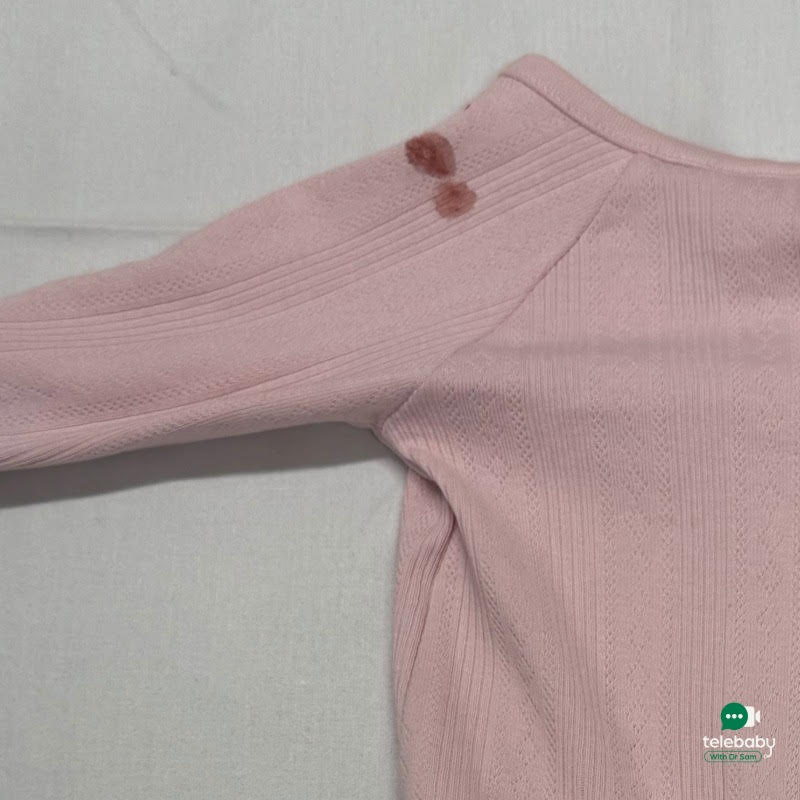
In most cases, it is safe to continue breastfeeding, and the small amount of maternal blood swallowed by the baby is not harmful. However, the cracked or bleeding nipple should be addressed, particularly if it is painful, not healing or related to problems with the baby’s latch.
Blood-stained vomit should not automatically be assumed to be caused by swallowed maternal blood. Seek prompt medical advice if there is no obvious maternal source, it occurs repeatedly, there is a large amount of blood or your baby appears unwell.
When should you seek help?
Seek prompt medical assessment if your baby:
• Has green vomit
• Has repeated or forceful projectile vomiting
• Has a large amount of blood in the vomit
• Is feeding poorly or refusing feeds
• Is not gaining weight as expected
• Has a swollen or tender abdomen
• Appears to be in significant or persistent pain
• Has breathing difficulties or blue lips or tongue
• Has a fever or is unusually sleepy
5. Why does my newborn sneeze and hiccup so much?
Frequent sneezing and hiccups are common newborn behaviours and usually do not mean that your baby is unwell.
Newborn babies often sneeze much more frequently than adults. This does not necessarily mean that they have a cold or an allergy.
A newborn’s nasal passages are very small, and sneezing is a normal reflex that helps clear milk, mucus, dust and other irritants from the nose.
Hiccups are also very common. They happen when the diaphragm, the muscle beneath the lungs, contracts suddenly, often after feeding or swallowing air.
Some babies hiccup after feeds, while others hiccup at seemingly random times. If your baby tends to hiccup after feeding, burping during and after the feed may help.
Hiccups usually do not bother the baby, stop on their own and do not require treatment.
6. What are the tiny white spots on my newborn’s face?
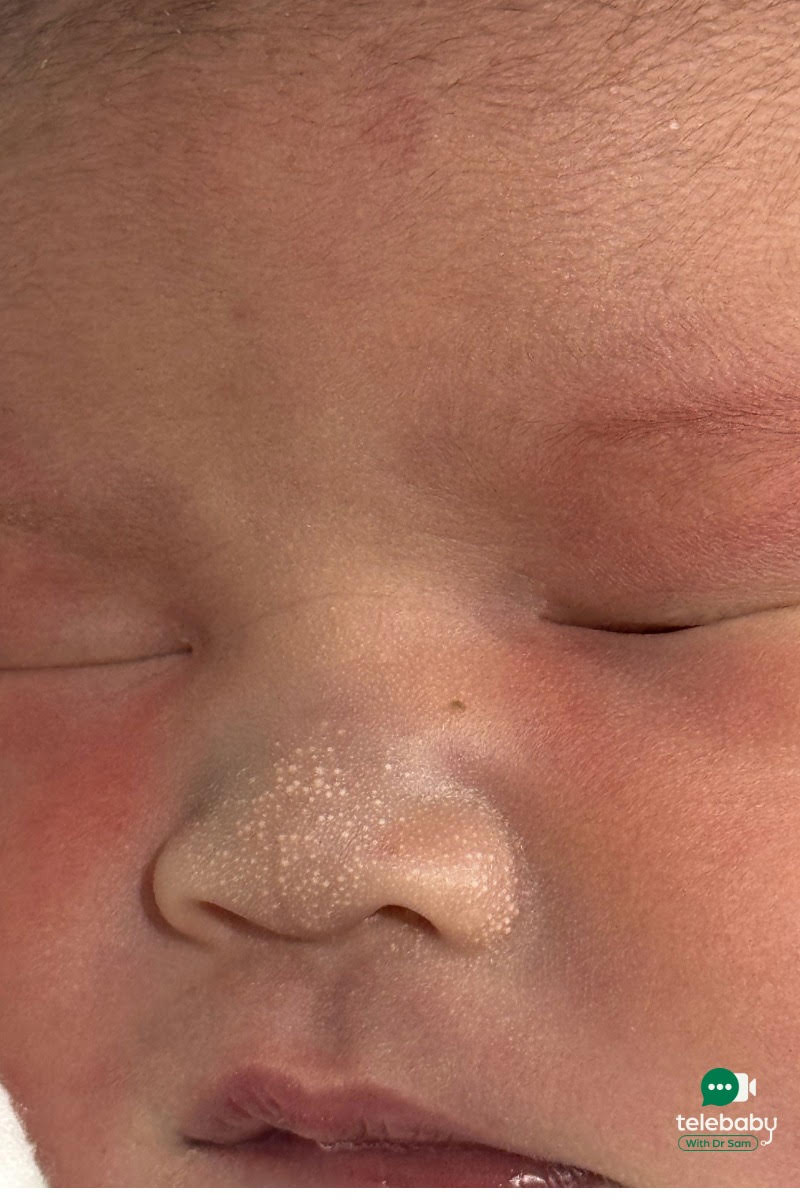
The tiny white spots commonly seen on a newborn’s face, particularly around the nose, are called milia. They affect around 40 to 50% of newborn babies.
Milia are small cysts that form when keratin, a natural protein found in the skin, becomes trapped beneath the skin’s surface.
They are not caused by poor hygiene, milk, an allergy or an infection.
Milia do not usually cause discomfort or itching and do not need creams or medication. They generally clear up on their own within a few weeks.
Do not squeeze or pick the spots, as this can irritate your baby’s skin and introduce infection.
Read more in my guide to milia and other common newborn rashes.
7. What causes pink or orange stains in a newborn’s nappy?
Pink, orange or reddish stains in a newborn’s nappy may be caused by urate crystals rather than blood. Urate crystals occur in up to 25% of newborn babies.
They often leave a pink or orange mark in the nappy. When dry, the stain may appear powdery, similar to brick dust, and is usually less bright red than fresh blood.
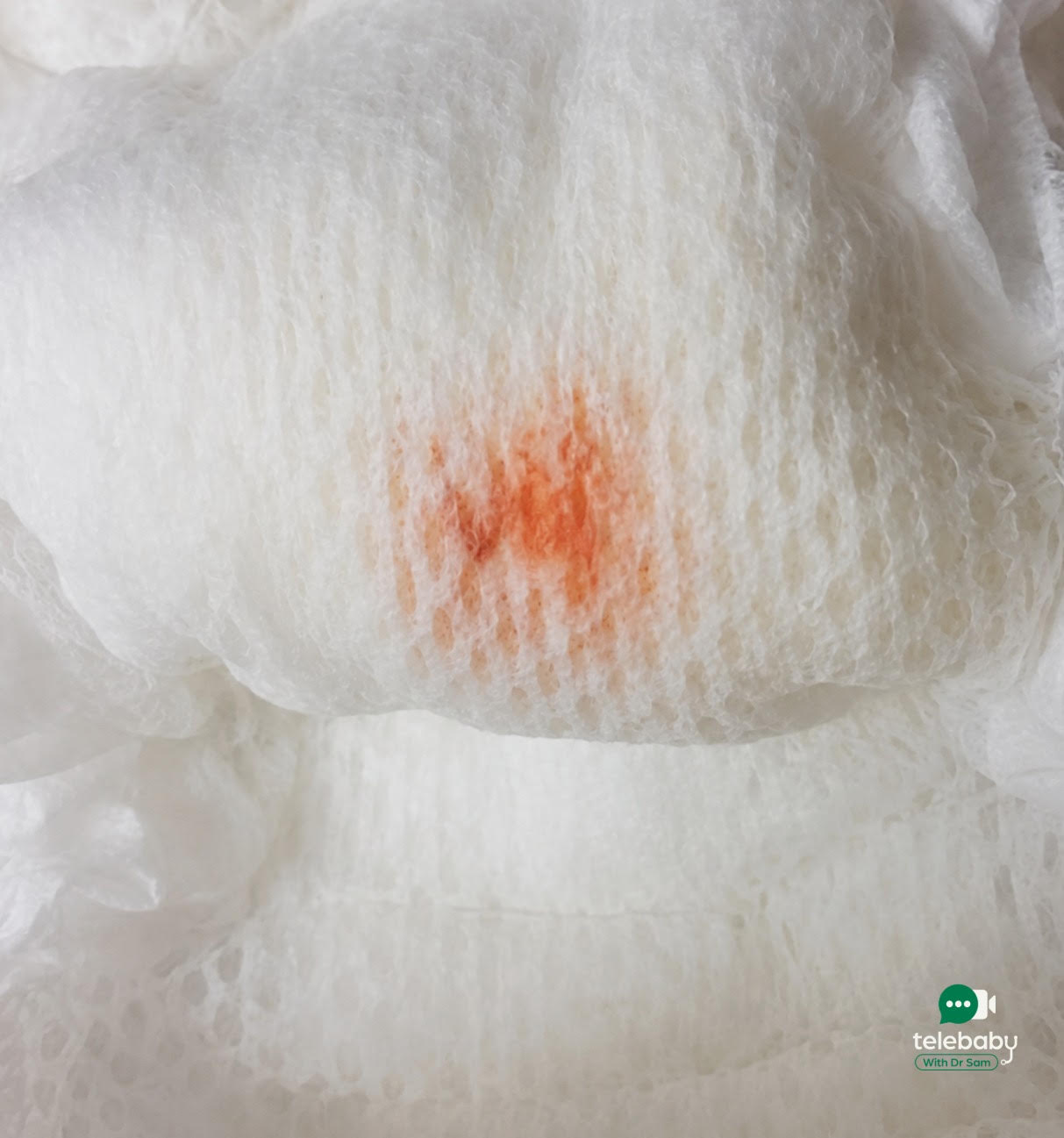
Urate is a substance naturally found in urine. During the first few days after birth, a newborn may pass small amounts of concentrated urine, making the crystals more visible in the nappy.
Urate crystals can be normal during the first few days of life while feeding and milk supply are becoming established. They should become less noticeable as your baby takes in more milk and produces more urine.
When should you seek help?
Speak to your doctor, midwife or child and family health nurse if:
• The staining persists beyond the first few days of life
• Your baby is feeding poorly
• Your baby has fewer wet nappies than expected
• You are unsure whether the stain is caused by urate crystals or blood
Keep the nappy or take a clear photograph to show your healthcare professional.
8. Is vaginal bleeding normal in a newborn baby?
A small amount of vaginal bleeding can be normal in a newborn girl during the first few days after birth.
This is sometimes called a mini-period or pseudomenstruation. It happens because the baby was exposed to maternal hormones during pregnancy. After birth, these hormone levels fall, which can cause a small amount of blood or blood-stained mucus.
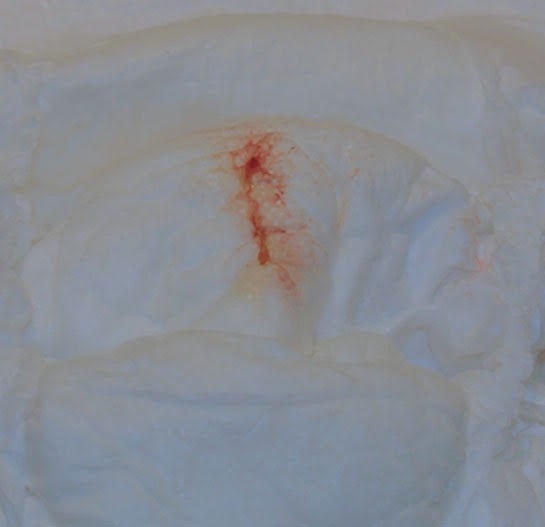
A white or clear vaginal discharge can also occur for the same reason. These changes are temporary and usually settle without treatment.
During nappy changes, gently clean the external area from front to back. There is no need to clean inside the vagina.
When should you seek help?
Have your baby checked if:
• The bleeding is heavy
• The bleeding continues beyond the first week
• The bleeding begins after it had previously stopped
• There is a foul-smelling discharge
• There is significant redness, swelling or an apparent injury
• Your baby has a fever, is feeding poorly or appears unwell
9. Why does my newborn have swollen breasts or discharge from their nipple?
Newborn girls and boys can both develop temporary breast swelling because of exposure to maternal hormones during pregnancy.
One or both breasts may be affected. Occasionally, a small amount of milky fluid may come from the nipple. This is sometimes called witch’s milk.
The swelling and discharge usually settle naturally as the hormones leave your baby’s body.
Do not squeeze or massage the breast tissue, and do not try to express the fluid. This can irritate the area, prolong the discharge and potentially introduce infection.
When should you seek help?
See your doctor if the breast:
• Becomes red or hot
• Becomes painful or very tender
• Becomes increasingly swollen
• Is much larger on one side
• Has pus or bloody discharge
Your baby should be assessed urgently if they develop a fever.
10. Why does my newborn suddenly startle and throw out their arms?
This sudden movement is usually the Moro reflex, also called the startle reflex. It is a normal newborn reflex that can look quite dramatic.
A sudden sound, movement or change in head position may cause your baby to throw out their arms and legs, open their hands and then quickly bring their arms back towards their body. They may also cry.
The Moro reflex is present from birth and is part of a newborn baby’s normal nervous system development. It is usually strongest during the first month, gradually becomes less noticeable and normally disappears by around 4 to 6 months of age.
Newborn babies may also have brief twitches or jerky movements during sleep. These movements are often normal, particularly when they occur only during sleep and stop when the baby wakes.
When should you seek help?
Speak to your doctor if:
• The Moro reflex appears much stronger on one side
• One arm does not move normally
• The movements are repetitive or rhythmic
• Jerking continues when the limb is gently held
• There is unusual staring or abnormal eye movement
• Your baby becomes blue, pale or unresponsive
• The episode occurs with breathing changes
• You are concerned that the movements could be seizures
A short video is often much more helpful than trying to describe the movement during an appointment. Record the movement only if it is safe to do so and your baby does not need immediate medical attention.
Urgent warning signs in a newborn
Seek urgent medical help if your baby:
• Has a temperature of 38°C or higher
• Has blue or grey lips or tongue
• Is struggling to breathe
• Is very floppy, unusually sleepy or difficult to wake
• Is refusing feeds or unable to feed normally
• Has green vomit
• Has seizure-like movements
• Looks or behaves very unwell
A baby younger than 3 months with a temperature of 38°C or higher should be taken to the nearest hospital emergency department immediately.
Call Triple Zero (000) if your baby is blue, unresponsive or experiencing severe breathing difficulty.
Other common newborn concerns
You may also find my other Telebaby articles helpful:
• Newborn umbilical cord care and belly-button concerns
• Blocked tear ducts and sticky eyes
• Newborn jaundice
Final thoughts
Newborn babies can look, sound and behave very differently from older babies and children. Irregular breathing, straining before passing a soft poo, frequent spit-ups, sneezing, hiccups, milia, urate crystals, hormone-related changes and sudden startle movements can all be part of normal newborn development.
The most reassuring signs are that your baby is feeding well, producing wet nappies, gaining weight and breathing comfortably.
Parents know their babies best. If something does not look or feel right, especially in a newborn baby, it is always appropriate to seek medical advice.
👉 Book your appointment here
Written by Dr Samuel Heitner